ICE Melting and the Soil Underneath: Somali-Minnesotans, Migration, and the U.S. American Pen
The vehicle of colonialism is dehumanization. What humanity do we owe to trash? Animals? Garbage? As Somalis cross borders, they are no longer only Somali. In some places, they are more – where mobility is seen as diversity, enrichment. In others, they are less – marked by their journeys and forced to assimilate to the dominant culture, the “better” one, the colonizing one.
And what happens if the Somali refuses? If their culture, language, morals, journeys, ideals, spirits are etched into their foreheads for all to see – immovable, irremovable. The dominant culture responds to this resistance with force. Somalis, and others marked by their nimble-footed differences, are stripped of their dignities, their families, their homes.
So, what humanity do we owe to those labeled as “garbage” by our very own president? That is the method, the tool, the bottom line. The ease to inflict pain, to ignore. I have always hated the word ‘resilient.’ As if it becomes the responsibility of the marginalised to overcome the barriers others have created. However, today, I welcome the word. As I write this piece, I think about all the moments I have seen on my phone hundreds of miles away, in which the resilience of Minnesota residents probably surprised the Trump administration and its accomplices.
The U.S. Immigration and Customs Enforcement (ICE) occupation of the Twin Cities and the greater Minnesota region is devastating. Images and videos of a brutalizing regime violently securing the white nationalist’s vision of a ‘perfect America’ flood my screens while our siblings and friends are living through it first-hand. And, to the dismay of those who inflict that pain, surviving.
Memories of a Land Left Behind
I write from the perspective of a second-generation U.S. American woman of Somali descent, and I feel the telling of this story is better because of it. My first memories of Somali lands are from my parents, the memories of my parents. The smells of trees of lemon, banana, and mango. The sounds of honking tuk-tuks and shouting street vendors and crashing waves against white sands. The towering architectures painting trading histories and colonial strongholds. The roots of their parents and their grandparents. Growing up, the dreams and stories of a Somalia frozen in nostalgia and nomadism engraved the walls of my childhood homes. A Somali home they had to run from.
Photo: My great grandfather Farah Abrar Fahiye, Chief Aqil (wiseman), standing with other tribal Aqils to welcome the British Royal Family to Borama in 1958 – two years before independence.
I remember stories from my Ayeeyo Qamar, my grandmother’s youngest sister, and her daughter Siman, of stepping over dead bodies lining the streets of Muqdisho after the fall of the city. Stories of my mother coming back home in the summers to the neighborhood children calling her gallo (white/pagan) in her new capri pants mixed with stories of my Abti Mohamed, my mother’s oldest brother, mistakenly killed by individuals assuming he shared the president’s clan after he had just secured a car to escape the capital with his family.
Somali stories live in simultaneous multiplicity. Many truths existing in a grand narrative of mobility. The Somali Diaspora resides within those truths, stretching across borders and continents. The global narrative heard, over and over again, is that of the state collapse in 1991. That is where the journeys of Somalis in Minnesota begin. And they are far from over.
Photo: Somali Dervish army in battle, 1902 [By: Richard Caton Woodville Jr for The Illustrated London News]
The Colonial Project and the 1991 Diaspora
While the Somali Diaspora is very well known, little is known, at least on a global scale, about the movement that preceded the contemporary diaspora – experiences of internal displacement, carving of land, and the splitting of tribes. Unlike other African countries created and drawn through the Scramble, Somalia is not primarily held together by artificial borders which created new identities to align with the new nation-state.
Nonetheless, Somalia as a nation-state is the aftermath of European (and later U.S. American) colonial projects. Split between five regions – Italian Somaliland (Somalia), French Somaliland (Djibouti), British Somaliland (Somaliland), Western Ethiopia, and Northern Frontier District (Northern Kenya); the Somali people unify themselves through language, ethnicity, and ways of life but yet are forced to live apart. An imperial imperative to divide and conquer, weaken. The endless coastline, the arid to lush lands, the stony hills all hold memories of one of the longest anti-colonial resistance efforts on the African continent: The Dervish movement.
Stories of their white robes billowing in the wind as they ride horseback, spears or arrows in hand, tens of thousands of Somali men, hailing from different tribes, fighting together for the land, their people. United through Islam and united against a common enemy: those who wish to encroach on Somali lands. Until their defeat by the British colonial government, those men on horseback fought against Ethiopian, Italian, and British imperialism. There is no modern Somali history without intervention from the West (and those propped up by the West), the aftereffects trickling down and inevitably leading to the large-scale diaspora we witness today.
Somalinimo: Finding Home in the Diaspora
The Somali Diaspora is externally known for many things – its size, ability to create homes geographically distant from homelands, and more recently: “fraudulent” daycares and welfare schemes prompting random white boys named Josh to “investigate.” Internally, however, the diaspora is a manifestation of the Somali’s commitment to family, those perceived as family, and those who become family. This is driven by a shared sense of Somali identity: Somalinimo.
Photo: My family sitting on my grandmother’s porch in Borama, Somalia
Somalinimo is the essence of being a Somali. As borders become visible and invisible stamps on a passport, Somalis carry their essence with them. #SomalinimoTillIDhimo. A shared sense of identity becomes homogenized as our parents’ memories cloud with nostalgia. Some scholars argue that Somali homogeneity is a “social myth.” Yet, as I explored through my Masters degree dissertation (later published as a monograph), Somali homogeneity – whether it is real or rather a perceived idea of oneness, of unity – aids Somali community formation outside of Somali lands. Somalinimo is lived through experience and made real through experience, especially in the diaspora.
After the fall of the Somali central government in 1991, the Somali diaspora increased tenfold, with its largest pockets finding home in the United Kingdom, United States, Yemen, United Arab Emirates, Norway, Sweden, South Africa, Egypt, and Kenya, to name a few. There’s a running joke online – you will find Somalis anywhere. And anywhere can become a home, since, of course, “Minnesota was promised to the Somalis 3,000 years ago”. Just the other day, I was scrolling on Instagram and came across a reel of a Somali man sitting in a park in Beijing speaking fluent Mandarin.
My parents initially found their way to the U.S. through education, with the opportunity to attend university in Minnesota (my dad) and California (my mom). Upon graduation, they each reunited with their respective families, who had already joined the diaspora. My father went to Italy, where my grandfather had been working (my dad loves to talk to my brother and I about his time in Rome; sentences always ending in “Capisce?”), and my mom went to Djibouti, where my grandmother had moved after the passing of my mother’s father.
They journeyed back to the U.S. as individuals and went through the naturalization process. I remember reciting the Pledge of Allegiance with my dad in the car on our drives to his Saturday pick up soccer games with uncles and distant uncles and tribal uncles in the community as he reminisced on the day he passed his citizenship test. I grew up with most of my immediate family members in the U.S. I have never experienced Somalinimo that was completely separate from where I grew up, thirty minutes outside of Washington D.C.
The U.S. is a predictable destination, arguably the most sought after. It’s the ‘American Dream’. Many Somalis experience something called “step migration” – an indirect journey to one’s final destination, with stops along the way for an indefinite period. In 2023, while living in South Africa, I learned that many Somali migrants living in the town of Bellville perceived their residence as ultimately temporary; South Africa as one step, possibly the final step, before settling in the West. In the States, the final destination for many Somali migrants is Minnesota.
The Road to the Twin Cities
Why Minnesota in particular? Personally, I found my own way to Minnesota for college because of the sizable Somali community, aunts and uncles, cousins, nieces and nephews – family to turn to when I needed comfort or time away from the dorms.
The largest Somali community in the U.S. lies in Minnesota, the largest in the West, the largest outside of the African continent. Dad buu dugsadaa dugaagna geed. “Humans seek shelter with other humans […]” I came across that Somali proverb in a book called The Invention of Somalia by Ali Jimale Ahmed. One of the first of its kind. So, if humans seek shelter with other humans, and Somalis seek shelter with other Somalis, Minnesota quickly becomes the ideal destination for the Somali on the move.
During my junior year of college, I interned at the Somali Museum of Minnesota, where I started leading guided tours of the museum. There is one section from the tour I remember particularly well, towards the beginning: Why Minnesota? Before entering the artifacts portion of the tour with objects like barkin, gambar, and fandhaal, we point to framed photos and posters on the wall showing smiling faces of Somali-Minnesotans and an overview of the policies and organisations making it possible for the state to become the ideal resettlement location.
The short answer is employment: finding work that did not require English language skills as well as organisations like Lutheran Social Services providing opportunities with refugee resettlement programs. I shared an earlier draft of this piece with my brother, as I typically do, and he reminded me of a defining moment: “Billan, didn’t Uncle Mo once tell us about the first flight filled with Somali refugees?” Somali migrants first arrived in Minnesota in waves from the early 90’s. The early arrivals resettled successfully, and more followed. Promises of safety, work, and ‘the American dream’. The continuation of a complex, nuanced relationship between Somali lands and the U.S., where refugees, migrants, and asylum seekers first touched ground and created a new home. A home where my Habo Fozia would, later, become the first Somali woman to hold a physician’s license.
While most Somalis are in the U.S. through “legal” processes, legality is tossed aside in favor of nativity – a visible, audible, singularly defined nativity. In a decolonial world, belonging will not be defined by citizenship, place of birth, race, or sounding “American.” The world has a long way to go; however, the Trump administration is actively showing the world they simply do not care. About rights, about decoloniality, about humanity.
Operation Metro Surge: “A Deadly Presence”
Since December 1st, 2025, the world has witnessed the deployment of ICE and Border Patrol agents in the thousands, using exhaustingly oppressive methods to dominate and target Somali-Minnesotans and other migrants in the Midwestern state. The official target populations of “Operation Metro Surge” are undocumented immigrants and those convicted of “violent crimes.” However, in reality, we are witnessing agents targeting anyone they think is undocumented; any Black and Brown person walking the streets of the Twin Cities is at risk of harassment and unjustified arrest.
While the U.S. has a history stretching to the present day of interfering in Somali affairs, both economically and violently, leading to Operation Metro Surge, some would describe Donald Trump’s continued comments regarding Somalis and Somali lands as obsessive – calling Somalia “filthy” and “disgusting,” describing the country as a “shithole country”, and his haunting focus on Ilhan Omar and her legitimacy as a congresswoman are just a few examples of this hyperfixation.
The Bishop Henry Whipple Federal Building, something I have never paid attention to before, has suddenly become infrastructure I recognize immediately. Following the fatal shooting of civilian observer Renée Good by an ICE agent in Minneapolis on January 7, 2026, the Whipple was surrounded by a metal wire fence, concrete barriers, and protesters greeting those released from ICE custody with a blanket and any assistance they may need. The temporary wire and concrete barricades have since been disassembled. However, at the height of Operation Metro Surge, this was the epicenter – manifesting Trump’s efforts for a white United States, a country that wishes to instead welcome white migrants from “better” countries like Norway, Sweden, and Denmark, people “who contribute to society.” The Guardian called ICE’s occupation of the Twin Cities and Minnesota a “deadly presence.” Harming people with no probable cause – a direct offense to the U.S. Constitution for what gain? To what end?
Photo: Screenshot, handwritten note taped to the trunk of a vehicle in Minnesota during Operation Metro Surge, 2026 [By: A friend of the author]
Sometimes it feels like a simulation. I remember the first time the occupation felt real. I got a text from one of my best friends living in Minnesota. It was a video of a handwritten note taped to the trunk of a black Lexus. “THIS WOMAN WAS PULLED FROM HER CAR BY ICE. PLEASE DO NOT HIT OR TOW.” Driverless cars litter the city streets. Masked men in camo-patterned uniforms bulldoze into homes with children.
Mutual Aid and the Architecture of Resistance
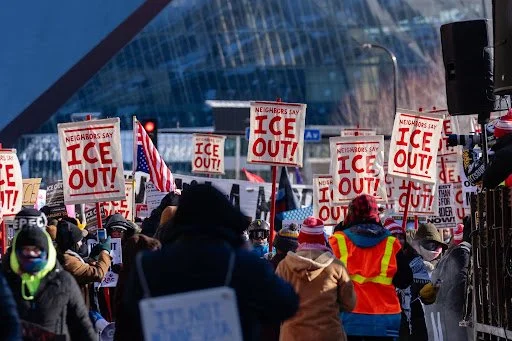
The Twin Cities of Minneapolis and St. Paul are not unknown to police violence as a result of protest and civilian mobilization. The community networks and mutual aid operations that solidified during the 2020 Uprising made the Cities a force to be reckoned with five and a half years later. Before the masked agents even ducked the first Twin Cities resident’s head into the back of a black Chevy Tahoe, the people were already on the move, heads held high, posters to the sky – observing, listening, recording, shouting.
To those outside of Minnesota, separated from the everyday lives of those experiencing this occupation, those only relying on what facts news outlets choose to air and in what manner – the impact of Operation Metro Surge is not just arrests. It’s people afraid to go to work. It’s observers lining the sidewalks so children can safely walk to and from school. It’s stores closing up as people shelter in their homes. It’s mutual aid networks saving families from being evicted. It’s also deadly.
Photo: The Whipple Federal Building in Fort Snelling, Minnesota, pictured here in 2014 [By: Gabriel Vanslette]. The Whipple Building is home to an ICE field office and functioned as a detention center and deportation base during Operation Metro Surge, December 2025- February 2026.
When masked men approach a Black or Brown person on the street or confront an observer – a mother, a teacher, someone’s child – the fear is not only arrest and transport to the Whipple Building. They fear for their lives, their wellbeing, their right to not be harmed or assaulted at the hands of government representatives. Julio Sosa-Celis. Adam Abdullah. Observers lose their lives. Renee Good. Alex Pretti. Whose freedom to protest really matters? Whose life matters? The working machines of colonialism and racialized capitalism, interlocked and mutually dependent, choose who lives and who dies. Even how.
The Trump administration actively and violently exerts its power over citizens. Showing a passport or the absence of a judicial warrant does not stop masked agents from detaining Somalis and others deemed “un-American” for days on end.
Drones Abroad, ICE at Home
The administration asserts tyrannical control, threatening deportation from the U.S., while sending drones to attack the very Somali lands that targeted communities should allegedly return to. In 2025 alone, the Trump administration sanctioned 43 drone attacks in Somali lands; attacks they claim are intended to target cells of Islamic State and Al Shabaab terrorism. I beg the question: exactly who are they looking for? And how do these attacks, this relentless destabilization, aid the pockets of those hegemonically in charge? Longstanding relationships between the U.S. and East African nations persist, affecting the operations and sovereignty of Somali lands for decades.
The Horn of Africa, Somali lands in particular, has never lived in isolation. From centuries-old trade routes to colonial ruins to Cold War battles to the age of ‘anti-terrorism’ that has defined the recent era, the geopolitical positioning of the Somali peninsula will always put the land and its peoples at risk of exploitation.
The ICE occupation weighs heavy on my heart. Yet, the relentless efforts and thriving of Somali-Minnesotans and observers throughout this period bring me back to life. I cannot help but think of my own family, their many journeys, my grandmother’s home in Boorama, my first visit to Liido Beach, my cousins telling me how they cannot wait for their U.S. migration dreams to become reality. The U.S. government is enacting its force onto people they are sworn to protect, choosing instead to redefine the meaning of citizen, of American, in a country that, up until 2025, through executive order, did not even have an official language.
Whistles in the Street
As Somalis cross borders, they are no longer only Somali. Their identity multiplies, stacked with labels. Migrant. Refugee. Somali-[insert western destination]. Terrorist. Neighbor. Advocate. Say Wallahi. Dual Citizen. Dhaqan Celis. Friend. Traveler. Still, those in power will attempt to freeze identities into place, as they have always done. Somali identities are flattened, made singular. Telling a single story – one of pain, violence, collapse, and illegality.
In Somali lands, clan comes first. In the diaspora, affinity to one’s clan becomes an affinity to one’s people. What we are seeing in Minnesota, however, is others rallying to their neighbors’ sides. Somalis in Minnesota are not only relying on themselves. There’s support. And that support is visibilizing the cracks and contours within the United States as a nation-state: where ICE freezes over or where ICE has no choice but to melt and dribble down the streets it is terrorizing.
Seeing a post on my phone rallying for funds to help save Somali-owned businesses in Karmel Mall gives me hope. Observers, relentless in their efforts to make sure those targeted are never alone, give me hope. Even the seemingly smallest actions, the whistles used to alert a street of ICE presence as the echoes travel down building after building, picking up new whistles on the way. That gives me hope.
Photo: Mothers of Cedar Riverside, Minneapolis holding an “ICE OUT of Minneapolis” sign at an iftar hosted by Cedar Riverside Protection Alliance to celebrate rapid responders during Operation Metro Surge, 2026 [By: Taylor Dahlin]
Guest edited by Dr. Dubie Toa-Kwapong, MRM’s Africa Migration Ethnographer
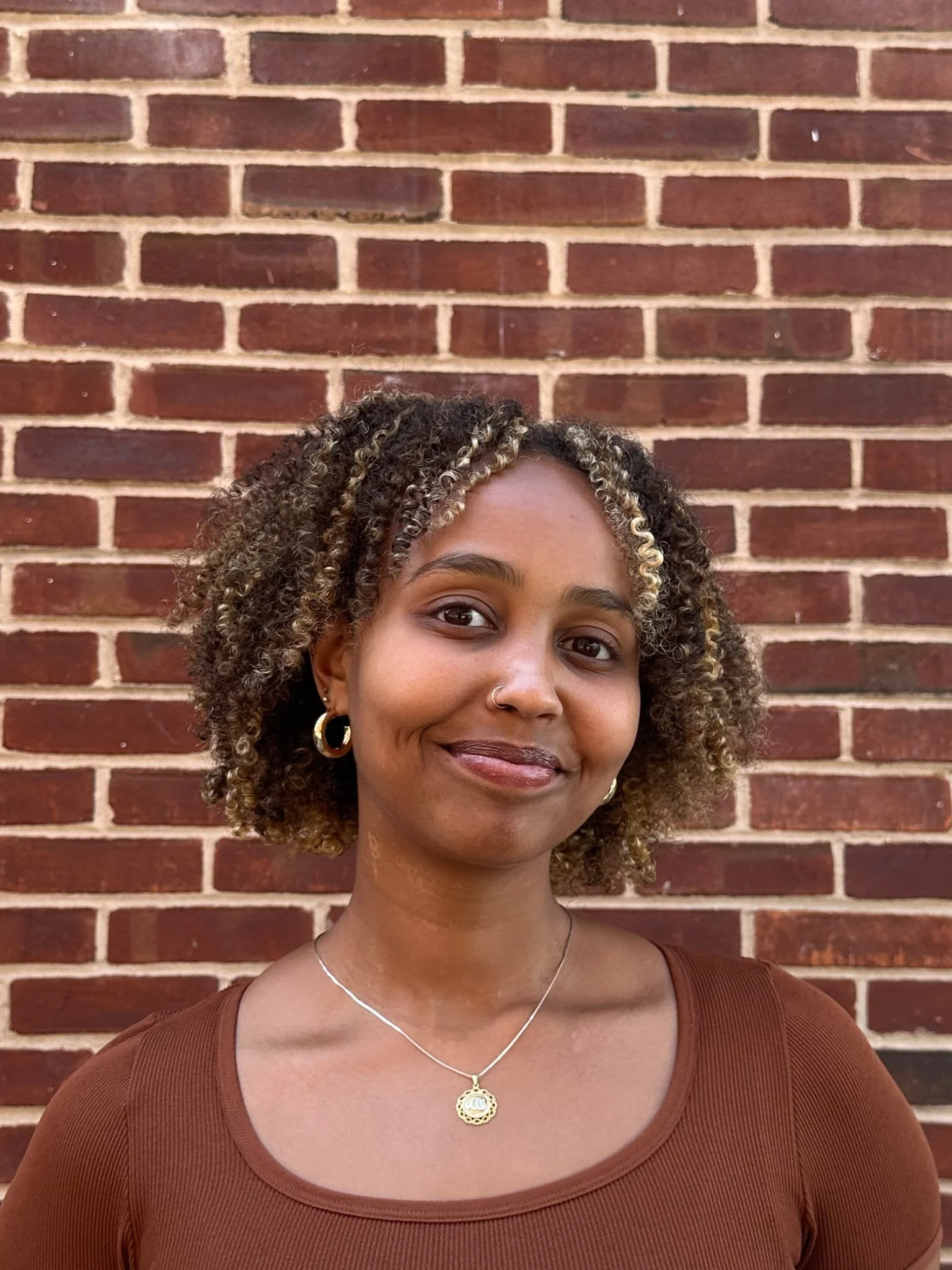
Billan Omar is a second generation immigrant born in Virginia to parents from Somalia who migrated to the U.S. in the early 90s. Billan is a Doctoral Research Fellow at the Institute for Humanities in Africa (HUMA), pursuing a PhD in Anthropology at the University of Cape Town, South Africa. She is the author of Soomaali Mi'yaa? Exploring Somalinimo in South Africa - an ethnography that dives into the heart of the Somali community in Cape Town South Africa and explores the intricate ways Somalinimo (Somaliness) is constructed and maintained through cultural tools. Billan received an MA in Anthropology from the University of Cape Town and a BA in International Studies and Anthropology from Macalester College. Billan's current research lies at the intersections of AI, ethics, knowledge productions, and decolonisation.
Email: billanomar@gmail.com
Instagram: @billan_omar